
By Mubashira Amanat, Founder – LoanMeterUSA.com | Last Updated: June 2026 | Reviewed for accuracy against 2026 CFPB amortization standards
| ⭐ Key Takeaways ✓ Biweekly payments = 26 half-payments/year = 13 full payments vs. 12 monthly ✓ A $300K loan at 7% saves $103,388 in interest with biweekly payments ✓ Biweekly payments shorten a 30-year mortgage by 6 years 4 months ✓ No refinancing needed – just change how and when you pay ✓ Use the free calculator to see your exact savings – no signup required |
If you are looking to pay off your mortgage faster, switching to biweekly mortgage payments is one of the simplest strategies available – no refinancing, no lump sum, and no change to your interest rate required.
It is called a biweekly mortgage payment, and the math behind it is surprisingly powerful. In 2026, with 30-year fixed rates holding above 6.5%, the savings potential is higher than it has been in over a decade.
This guide walks through exactly how biweekly payments work, how much you save at different loan amounts, and how to set it up with your lender – today, for free.
Key Takeaways: Biweekly Mortgage Payments
- Biweekly mortgage payments divide your monthly payment in half, paid every two weeks – resulting in 26 half-payments (13 full payments) per year.
- On a $300,000 loan at 7%, switching to biweekly mortgage payments saves $103,388 in interest and cuts your loan term by over 6 years.
- Biweekly mortgage payments work at any loan size – the savings scale proportionally from $200K to $600K mortgages.
- Most lenders support biweekly mortgage payments at no extra cost – confirm with yours before switching.
What Is a Biweekly Mortgage Payment?
A biweekly mortgage payment is a repayment schedule where a borrower pays half of their monthly mortgage amount every two weeks, resulting in 26 half-payments – equivalent to 13 full monthly payments – per year instead of the standard 12.
That one extra full payment each year goes entirely toward your loan principal. Because mortgage interest is calculated on your remaining balance, reducing the principal faster creates a compounding savings effect that grows every year over the life of the loan.
The effect is not marginal. Over 30 years, that one extra payment per year eliminates years of debt and tens of thousands in interest charges.
Biweekly vs Monthly Mortgage: Side-by-Side Numbers (2026)
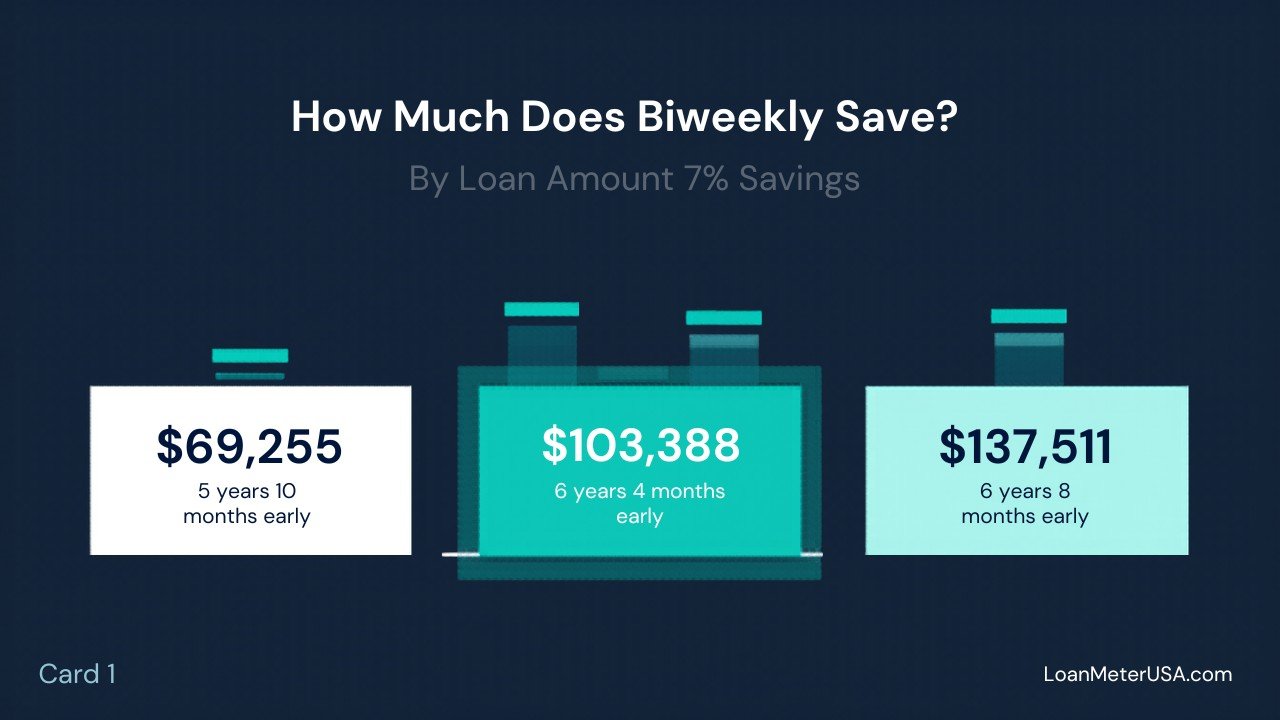
Here is exactly what biweekly payments save on three common loan sizes at 7% interest – the approximate 30-year fixed rate in mid-2026 per Freddie Mac Primary Mortgage Market Survey data:
| Loan Amount | Monthly Payment | Total Interest (Monthly) | Total Interest (Biweekly) | Interest Saved | Years Saved |
|---|---|---|---|---|---|
| $200,000 | $1,331 | $279,018 | $210,093 | $68,925 | 6 yr 4 mo |
| $300,000 | $1,996 | $418,527 | $315,139 | $103,388 | 6 yr 4 mo |
| $400,000 | $2,661 | $558,036 | $420,185 | $137,851 | 6 yr 4 mo |
The savings on a $300,000 mortgage exceed $103,000 in interest and eliminate more than 6 years of payments. To calculate your exact savings, use the free biweekly mortgage calculator at LoanMeterUSA.com – no signup required, results instant.

Why Biweekly Payments Work: The Math Explained
The mechanism is straightforward. You are making the equivalent of one extra full monthly payment per year, applied directly to your principal. Here is the arithmetic on a $300,000 loan at 7%:
- Monthly schedule: 12 payments × $1,996 = $23,952 paid per year
- Biweekly schedule: 26 payments × $998 = $25,948 paid per year
- Difference: $1,996 per year – exactly one extra monthly payment
That $1,996 does not go toward interest. It reduces your principal balance. A lower principal means less interest accrues in every future payment period – creating a compounding acceleration effect.
Run your own numbers: try the free biweekly mortgage calculator – enter your exact loan amount, rate, and term for a personalized result.
Is a Biweekly Mortgage Worth It For Everyone?
Biweekly payments make financial sense for most homeowners. But your full financial picture matters.
Biweekly payments are the right move if:
- You have no high-interest debt (credit cards or personal loans above 10%)
- You have a funded emergency reserve – at least 3 months of expenses
- You plan to stay in the home long enough to realize the savings (generally 5+ years)
- Your lender applies biweekly payments to principal, not to a suspense account
Prioritize other goals first if:
- You carry credit card debt above 15% – that interest rate costs more than biweekly savings earn
- You have no emergency fund – financial stability comes before aggressive payoff
- You are early in your career with room to maximize 401(k) or Roth IRA contributions
How to Set Up Biweekly Mortgage Payments in 2026
Option 1: Direct With Your Lender (Best Option)
Call the number on your mortgage statement and ask: “Can I set up biweekly payments with the extra half-payment applied directly to my principal?” Most servicers allow this at no charge. Confirm that the extra payment is applied to principal immediately – not held as a credit – and that there is no setup fee.
Option 2: DIY Extra Principal Payment (Works Everywhere)
If your lender does not offer biweekly scheduling, divide your monthly payment by 12 and add that amount to each monthly payment as extra principal. Over a full year, this equals one additional monthly payment – the same outcome as biweekly scheduling, at zero cost.
| Strategy | Extra Principal/Year | Setup Complexity | Flexibility | Best For |
|---|---|---|---|---|
| Biweekly payments | 1 full payment | Low | High | Most borrowers |
| Extra $100/month | $1,200 | Low | High | Budget-conscious |
| One lump sum/year | Variable | Low | High | Bonus earners |
| Refinance to 15-year | Much higher | High | Low | Highest earners |
Why 2026 Is an Especially Good Time to Switch
In mid-2026, the 30-year fixed mortgage rate is averaging 6.7–7.1% according to Freddie Mac’s Primary Mortgage Market Survey. At these rate levels, the compounding interest savings from biweekly mortgage payments are near a 15-year high – making this one of the best moments to switch from monthly to biweekly mortgage payments.
| Interest Rate | Biweekly Savings ($300K) | Years Eliminated | Rate Environment |
|---|---|---|---|
| 4.0% | $28,145 | 3.8 years | 2020–2021 low rates |
| 5.5% | $52,600 | 4.5 years | 2022–2023 rising rates |
| 7.0% | $103,388 | 6 yr 4 mo | 2024–2026 current |
The Bottom Line
Biweekly mortgage payments are one of the highest-return, lowest-risk financial decisions available to homeowners. On a typical 30-year mortgage at current 2026 rates, the strategy saves $68,000–$137,000 in interest and eliminates over 6 years of payments – at zero cost. According to the Consumer Financial Protection Bureau, biweekly payment plans can significantly reduce total interest costs and loan duration for most borrowers.
→ Calculate your biweekly savings now – free, no signup required
Frequently Asked Questions
How much does switching to biweekly mortgage payments save?
Switching from monthly to biweekly mortgage payments saves between $28,000 and $137,000 in interest on a typical 30-year loan, depending on loan size and rate. On a $300,000 mortgage at 7%, biweekly payments save $103,388 in interest and eliminate 6 years and 4 months of payments – with no refinancing required.
How much do biweekly payments save on a $300,000 mortgage?
On a $300,000 mortgage at 7% over 30 years, biweekly payments save $103,388 in total interest and pay off the loan 6 years and 4 months early. Monthly payment: $1,995.91. Biweekly payment: $997.95 every two weeks.
Is biweekly mortgage better than monthly?
Yes, for most borrowers. Biweekly payments result in 26 half-payments (13 full payments) per year instead of 12, accelerating payoff and reducing total interest significantly – without refinancing or changing your loan terms.
Does biweekly mortgage save money if interest rates are low?
Yes, but less dramatically. At 4% on a $300,000 loan, biweekly payments save approximately $28,000 and 3.8 years. At 7%, savings exceed $103,000 and 6+ years. Higher rates amplify the benefit significantly.
Can I switch to biweekly mortgage payments after closing?
Yes – no refinancing needed. Contact your loan servicer and ask to set up biweekly payments with the additional amount applied directly to principal. This can be done at any point during the loan term.
Do lenders charge fees for biweekly mortgage payments?
Most lenders offer biweekly payment programs for free. Some servicers charge $100–$300 to enroll – always ask before agreeing. If your lender charges a fee, use the DIY method: add 1/12 of your monthly payment as extra principal each month for the same result at no cost.
What is the difference between biweekly and twice monthly mortgage payments?
Biweekly means paying every two weeks – 26 times per year. Twice monthly means paying on two set dates per month – 24 times per year. Only biweekly creates an extra full payment annually. Twice-monthly payments offer no payoff acceleration.
Is a biweekly mortgage worth it in 2026?
Yes – especially in 2026. With 30-year fixed rates at 6.7–7.1%, biweekly savings are near a 15-year high. A $300,000 mortgage at 7% saves $103,388 in interest with biweekly payments. At current rate levels, the strategy has rarely offered more value.
Does biweekly mortgage reduce principal faster?
Yes. Because you make 13 full payments per year instead of 12, your principal balance decreases more quickly. This reduces the interest calculated on every future payment, creating a compounding acceleration effect over the life of the loan.
Educational Disclaimer: All calculations on LoanMeterUSA are based on standard amortization formulas and are provided for educational and informational purposes only. Results do not constitute financial advice. Consult a licensed mortgage professional for guidance specific to your situation.
See also: Biweekly Mortgage Calculator
Ready to run the numbers? Use our free biweekly mortgage calculator to model your exact savings. For a deeper dive, see How Much Does a Biweekly Mortgage Payment Save? and our full mortgage calculator.
Ready to run the numbers? Use our free biweekly mortgage calculator to model your exact savings. For a deeper dive, see How Much Does a Biweekly Mortgage Payment Save? and our full mortgage calculator.
Ready to run the numbers on your own loan? Our biweekly mortgage calculator shows you exactly how many years and dollars you save – just enter your current loan details.
Ready to see your numbers? Our biweekly mortgage calculator shows exactly how many years and dollars you save switching from monthly to biweekly – just enter your current loan details. Takes 30 seconds.
Pingback: Mortgage Amortization Schedule Explained: Save $100K+ With This Complete 2026 Guide - LoanMeterUSA