- On a $300,000 loan at 7%, biweekly payments save ~$52,000 in interest
- You pay off your mortgage 4–5 years early — without refinancing
- The “trick”: 26 half-payments = 13 full payments per year instead of 12
- You don’t need your lender’s biweekly program — there’s a free DIY method
- Use our free biweekly mortgage calculator to see your exact savings
Switching to a biweekly mortgage payment schedule saves the average US homeowner $40,000–$65,000 in interest and cuts 4–5 years off a 30-year loan. You don’t change your interest rate, loan amount, or lender. The only thing that changes is how often you pay.
Below, we break down the exact math on a $300,000 loan at 7%, show a side-by-side comparison, explain how the savings actually work, and answer every common question about biweekly mortgage payments.
A biweekly mortgage payment means you pay half your monthly mortgage payment every two weeks instead of one full payment each month.
Since there are 52 weeks in a year, you make 26 half-payments — which equals 13 full monthly payments, not 12. That one extra payment per year is quietly applied entirely to your principal balance, which is where all the savings come from.
Monthly payment: $1,996
Biweekly payment: $998 (half of monthly)
Payments per year: 26 × $998 = $25,948
vs. monthly: 12 × $1,996 = $23,952
Extra per year: $1,996 — one full extra payment, straight to principal
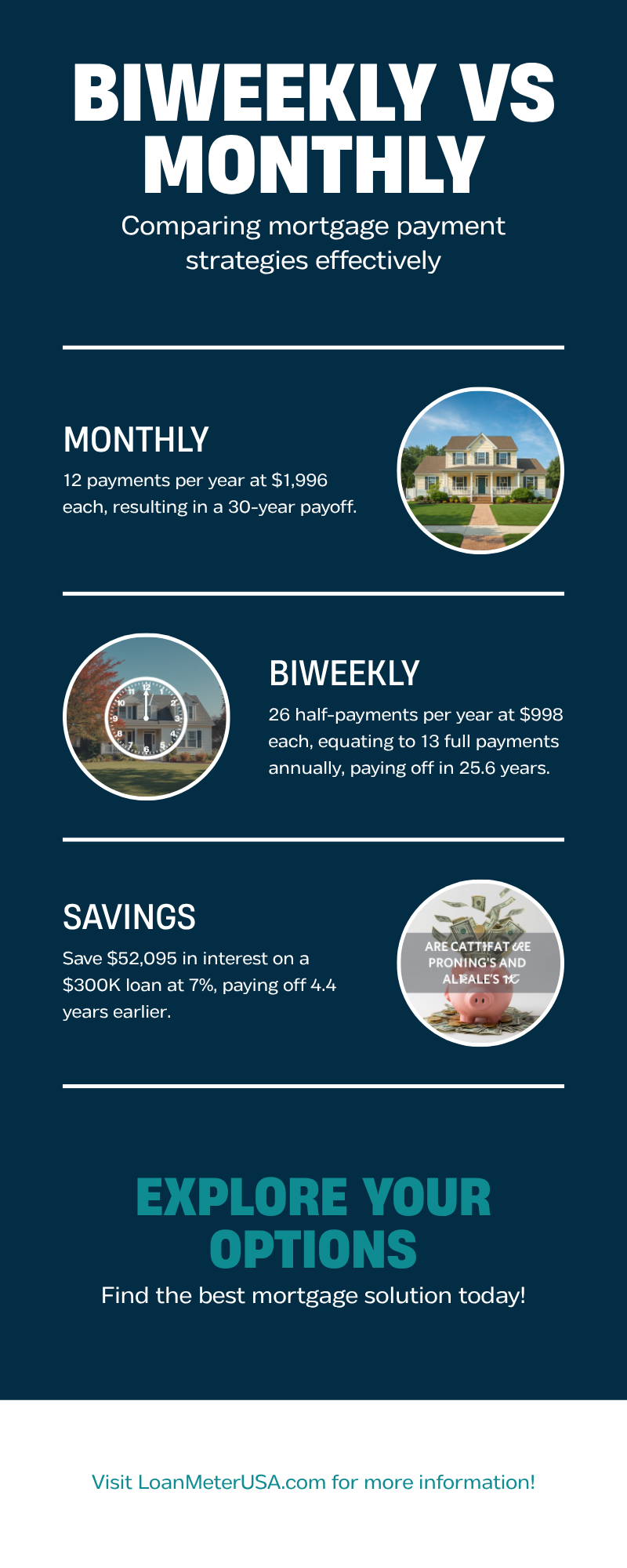
Here are the real numbers on a $300,000 30-year fixed mortgage at 7% interest:
| Payment Type | Monthly Amount | Total Interest | Payoff Time |
|---|---|---|---|
| Monthly (standard) | $1,996/mo | $418,527 | 30 years |
| Biweekly | $998/2 wks | $366,432 | ~25.6 years |
| 💰 You Save | $52,095 | 4.4 years |
Want to see your numbers? Use our free biweekly mortgage calculator — enter your loan balance, rate, and term to get your exact interest savings and payoff date.
Biweekly Mortgage Payment Savings at Different Loan Amounts (7% Rate)
| Loan Amount | Monthly Payment | Interest Saved | Years Saved |
|---|---|---|---|
| $200,000 | $1,331 | ~$34,700 | ~4.4 yrs |
| $300,000 | $1,996 | ~$52,095 | ~4.4 yrs |
| $400,000 | $2,661 | ~$69,500 | ~4.4 yrs |
| $500,000 | $3,327 | ~$86,800 | ~4.4 yrs |
Notice the years saved stays consistent — it’s always about 4.4 years on a 30-year loan, regardless of the loan amount. That’s because the math is proportional. The dollar savings scale with the loan size.

| Factor | Monthly | Biweekly |
|---|---|---|
| Payments per year | 12 | 26 (= 13 full) |
| Extra principal paid/year | $0 | 1 full payment |
| Interest saved ($300K, 7%) | — | $52,095 |
| Payoff time (30-yr loan) | 30 years | ~25.6 years |
| Refinancing required? | N/A | No |
| Aligns with biweekly paycheck? | No | Yes |
| Cost to set up | Free | Free (DIY method) |
The savings come from two forces working together:
1. One extra payment per year. There are 52 weeks in a year. Making a payment every 2 weeks means 26 payments. Half-payments × 26 = 13 full payments. Monthly payments only give you 12. That 13th payment goes directly to your principal.
2. Earlier principal reduction compounds over time. Every dollar of principal you pay off reduces the balance that interest is calculated on next month. By reducing your balance slightly faster in year 1, you pay less interest in year 2, which means even more of year 3’s payment goes to principal — and so on for 25+ years. This snowball effect is what turns $1,996/year in extra payments into $52,000 in total savings.
Most conventional, FHA, VA, and USDA loans allow extra principal payments without prepayment penalties. However, not every lender offers an official biweekly payment program, and some that do charge a setup fee ($300–$400) or monthly service fee.
You can check your mortgage note or call your servicer to confirm. The key question to ask: “If I make a payment every two weeks, will you apply it to my balance immediately, or hold it until my monthly due date?”
If they hold it — use the DIY method below instead.
You don’t need your lender’s program. Here’s the free alternative that achieves the exact same result:
- Divide your monthly payment by 12. Example: $1,996 ÷ 12 = $166.33
- Add that amount to each monthly payment as extra principal. Pay $1,996 + $166.33 = $2,162.33 every month.
- Label it “additional principal” when submitting payment. Make sure your lender applies the extra to principal, not toward next month’s payment.
- Do this every month and you replicate one full extra payment per year — the same result as the biweekly schedule.
This method also works if your income is monthly and a biweekly cadence doesn’t fit your budget.
For authoritative background on mortgage amortization and consumer rights, the Consumer Financial Protection Bureau’s mortgage explainer is a helpful government resource. The HUD.gov homebuyer guide also covers mortgage payment options and borrower protections in detail.
Biweekly payments make the most sense if:
- ✅ You get paid biweekly and want payments to match your paycheck schedule
- ✅ You plan to stay in the home for 10+ years (savings compound significantly over time)
- ✅ You have no high-interest debt (credit cards, personal loans) — pay those first
- ✅ Your emergency fund is solid (3–6 months of expenses)
- ✅ Your mortgage doesn’t have a prepayment penalty
It may not be the best move if:
- ❌ You carry high-interest credit card debt (7% mortgage interest costs less than 24% credit card interest)
- ❌ You’re planning to sell or refinance within 5 years
- ❌ Your cash flow is already tight — don’t skip essential expenses to pay extra on your mortgage
Not sure which loan type you have? Check out our standard mortgage calculator for conventional loans, or use our amortization calculator to see your full payment schedule.
Enter your loan details and see exactly how much you save in interest — and how many years earlier you’ll be mortgage-free.
Try the Free Biweekly Calculator →On a $300,000 30-year mortgage at 7%, switching to biweekly payments saves approximately $52,095 in interest and pays off the loan about 4.4 years early. Your biweekly payment would be $998 (half of the $1,996 monthly payment), but you make 26 payments per year instead of 24 — adding one extra full payment annually.
No. Biweekly mortgage payments do not hurt your credit. As long as your lender receives at least the minimum payment by the due date, your credit score is unaffected. Making extra principal payments actually improves your credit over time by lowering your debt-to-income ratio and overall debt balance.
Biweekly is better if your goal is to pay less interest and pay off your home faster. The biweekly mortgage schedule results in 13 full payments per year instead of 12, which reduces your principal balance faster and cuts thousands in interest over the loan term. Monthly is simpler if you prefer fewer transactions or if your cash flow is tight.
Biweekly mortgage payments typically take 4 to 5 years off a 30-year mortgage, regardless of the loan amount. The exact number depends on your interest rate — higher rates mean slightly more years saved because the extra payment fights more against accruing interest.
Yes. While some lenders charge $300–$400 for their official biweekly mortgage program, you can replicate the same result for free using the DIY method: divide your monthly payment by 12 and add that amount as extra principal to each monthly payment. This achieves the same one-extra-payment-per-year effect without any fees.
Missing a biweekly mortgage payment doesn’t immediately put you in default as long as your total payments cover the required monthly minimum by your due date. However, you lose the interest-saving benefit of that extra payment. If you’re on your lender’s official biweekly program, check your agreement — some have specific terms for missed payments.
Yes. FHA, VA, and USDA loans all allow extra principal payments without prepayment penalties. The biweekly mortgage payment strategy works the same way on government-backed loans as it does on conventional loans. Always confirm with your loan servicer that extra payments are applied immediately to principal, not held until your next due date.
It depends on your interest rate. If your mortgage rate is 7% or higher, paying extra on your mortgage gives you a guaranteed 7% return — hard to beat safely in the market. If your rate is below 5%, long-term stock market returns (historically 7–10%/year) may outperform paying off your mortgage early. Consider both your rate and your risk tolerance before deciding.
- Biweekly Mortgage Calculator — See your exact savings and payoff date
- Mortgage Calculator — Calculate monthly payments for any loan
- Amortization Calculator — Full payment schedule, month by month
See the math for yourself with our free biweekly mortgage calculator. You can also read our guide on how biweekly mortgage payments work and compare monthly payment scenarios with our mortgage calculator.
See the math for yourself with our free biweekly mortgage calculator. You can also read our guide on how biweekly mortgage payments work and compare monthly payment scenarios with our mortgage calculator.