If you’re wondering how to pay off a 30-year mortgage in 20 years, you’re not alone. At today’s rates of 6.5–7%, a $300,000 mortgage costs you nearly $418,000 in interest over 30 years. For the first decade, almost half of every payment goes to the bank, not your home.
But here’s what most articles miss: you don’t need to refinance into a 15-year mortgage or double your payment to escape early. Paying off a 30-year mortgage in 20 years is realistic for most homeowners – it typically requires just $300–$400 per month extra – and the interest savings are dramatic.
This guide breaks down 5 proven strategies, with real numbers, so you can choose what works for your budget. Use our free Mortgage Calculator to model your own payoff timeline as you read.
How to Pay Off a 30-Year Mortgage in 20 Years: Is It Realistic?
Yes – and it’s more achievable than most people think. The extra amount you need depends on your loan balance and interest rate, but here’s a quick reference:
| Loan Amount | Interest Rate | Extra/Month Needed | Total Interest Saved |
|---|---|---|---|
| $200,000 | 6.5% | ~$210/month | ~$85,000 |
| $300,000 | 7.0% | ~$350/month | ~$166,000 |
| $400,000 | 7.0% | ~$465/month | ~$221,000 |
That $350/month on a $300K loan – about what many households spend on dining out or subscriptions – cuts 10 years and $166,000 in interest off your mortgage. To see the exact number for your loan, run your figures through our mortgage payoff calculator.
Strategy 1: Make Extra Monthly Principal Payments
This is the most direct and flexible approach. Every dollar above your required payment that goes toward principal reduces the balance on which future interest is calculated – which compounds the savings over time.
How it works: On a $300,000 loan at 7% for 30 years, your standard monthly payment is approximately $1,996. Add $350/month = ~$2,346 total. Result: payoff in roughly 20 years, saving ~$166,000 in interest.
Even small amounts add up fast:
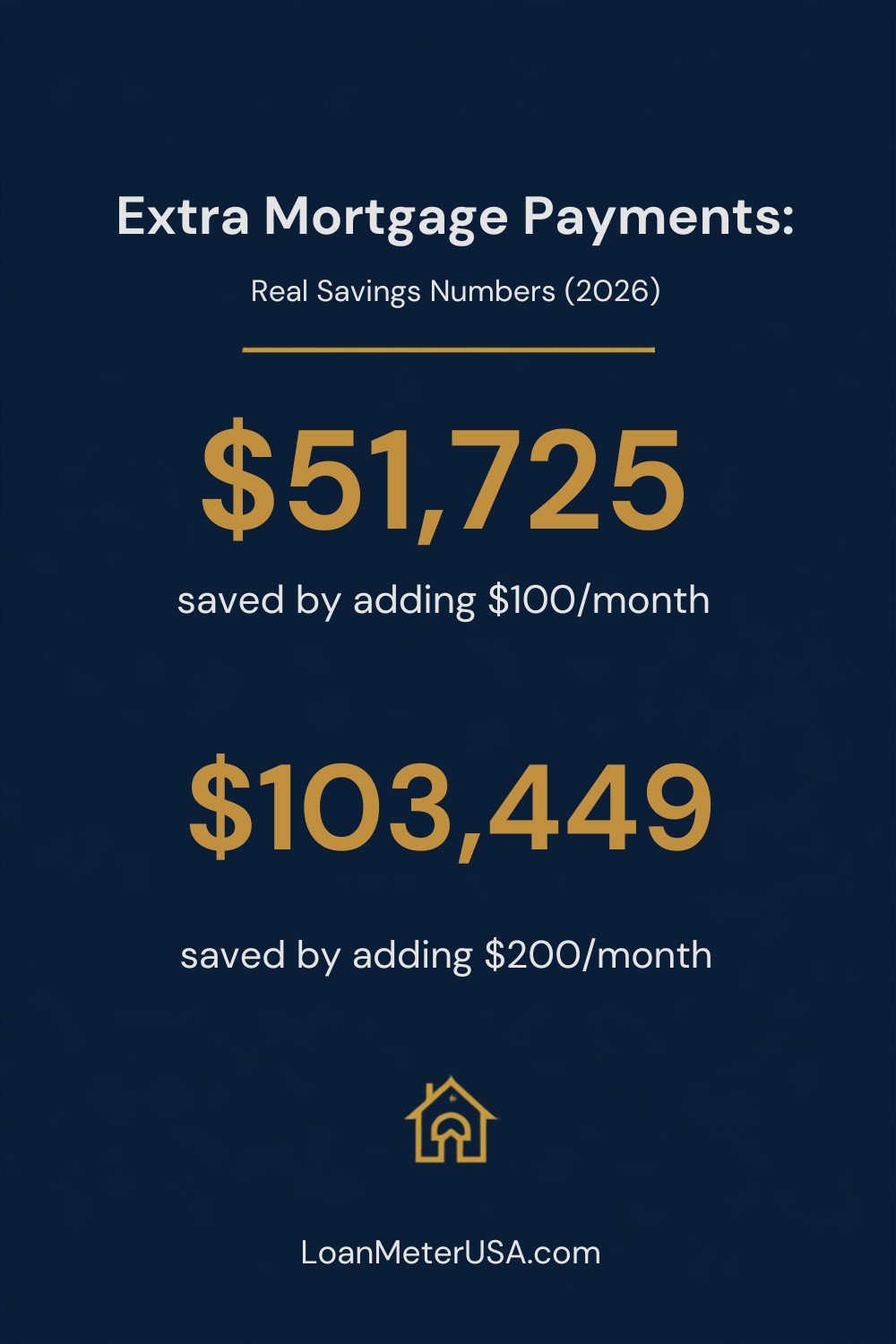
- $100/month extra → shaves ~5 years, saves ~$50,000
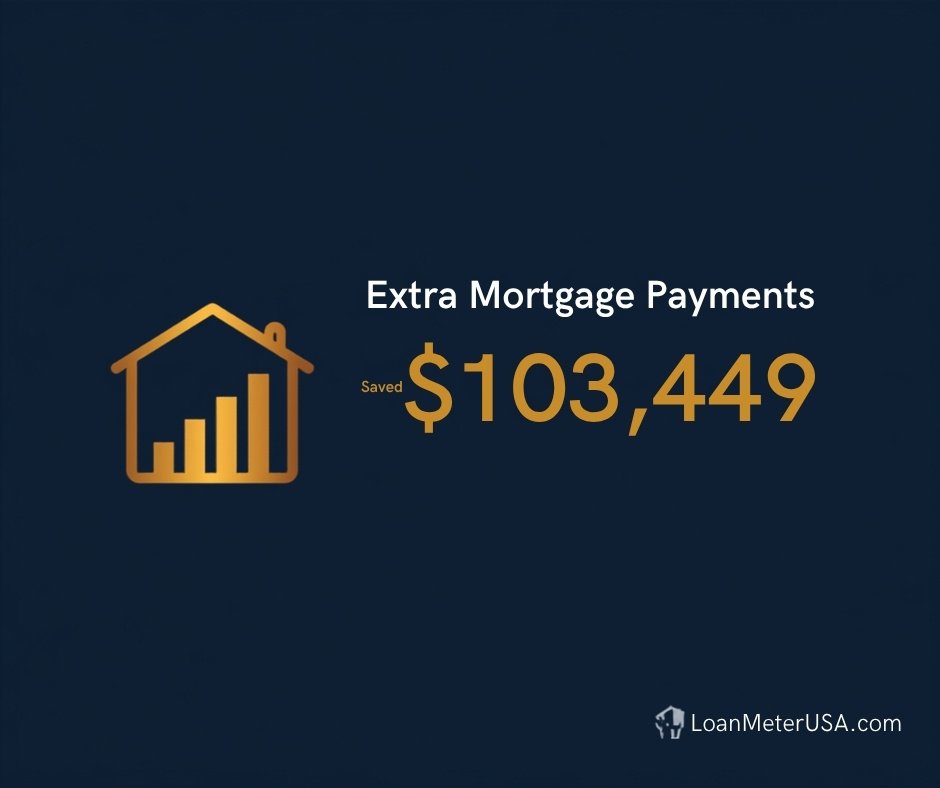
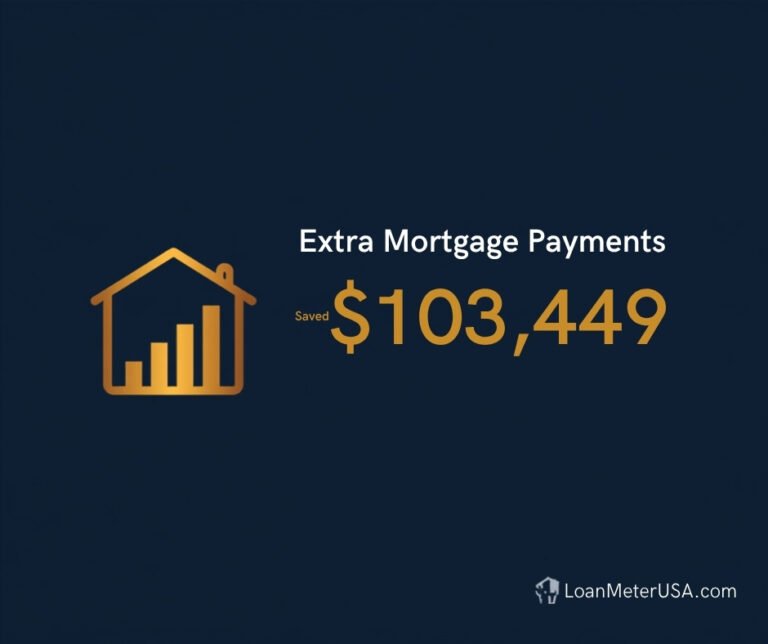
- $200/month extra → shaves ~7.5 years, saves ~$90,000
- $350/month extra → shaves ~10 years, saves ~$166,000
Important: Always specify that extra payments should be applied to principal only. Call your loan servicer or use the designated field in their online portal – otherwise some servicers apply the overpayment to your next month’s payment instead, which doesn’t reduce your term.
Smart tip: Use annual raises. A 1% salary increase on an $80,000 income = $800/year extra. Apply that windfall each year and your payoff timeline shrinks steadily without feeling the pinch monthly.
Watch out for: Prepayment penalties. These are rare on loans originated after 2014 (the CFPB restricted prepayment penalties after 2014), but worth verifying with your servicer before making large extra payments.
Strategy 2: Switch to Biweekly Payments
Instead of paying once per month, you pay half your mortgage payment every two weeks. Since there are 52 weeks in a year, you make 26 half-payments – which equals 13 full monthly payments per year instead of 12. That one extra payment per year is quietly credited toward principal.
Results on a $300K loan at 7%: Saves approximately 4–5 years off your 30-year term and around $60,000 in interest. On its own, biweekly payments won’t hit 20 years – but combined with a small monthly extra payment, you can.
For a full breakdown of biweekly payment mechanics and how to set it up, see our guide: How Biweekly Mortgage Payments Work.
How to set it up for free:
- Ask your loan servicer if they offer a biweekly payment program (many do, at no charge)
- Or set up an automatic bank transfer every two weeks yourself – send each half-payment directly to your servicer labeled “principal only”
Warning: Avoid third-party “biweekly payment services” that charge $300–$500 to set this up for you. There is no benefit they provide that you can’t do yourself in 10 minutes through your bank.
Strategy 3: Apply Lump Sum Payments When You Get Them
Tax refunds, work bonuses, inheritance, or a side hustle windfall – any large one-time amount applied to your principal can shave months or years off your mortgage, with no change to your regular monthly payment.
Example: A $5,000 lump sum payment in year 5 of a $300K loan at 7% saves approximately $18,000 in total interest and cuts about 14 months off your term. The earlier in the loan you make it, the bigger the impact.
Average US tax refund: ~$3,000. Applied once per year to principal, this alone can cut 3–4 years off a 30-year mortgage.
As with extra monthly payments, always send lump sum payments separately with a clear note: “Apply to principal only.” Confirm with your servicer that it posted correctly.
Strategy 4: Refinance to a 20-Year Mortgage
If you want to know how to pay off a 30-year mortgage in 20 years with a guaranteed outcome, refinancing directly to a 20-year loan is the cleanest approach.
The cleanest path to a 20-year payoff is to refinance directly into a 20-year loan. This locks your payoff date in contractually and gives you a lower interest rate than a 30-year mortgage (typically 0.25–0.5% lower).
When refinancing makes sense:
- Current mortgage rates are at least 0.75% lower than your existing rate
- You plan to stay in the home for at least 3 more years (to recoup closing costs)
- Your credit score has improved significantly since your original loan
- You’re early in your loan term (refinancing in year 20 of 30 rarely makes sense)
Closing costs: Typically $3,000–$6,000. Factor this into your break-even calculation. If you save $200/month in interest, you break even in 15–30 months – reasonable if you’re staying long-term.
At current rates (2026): With 30-year rates around 6.5–7%, refinancing only makes financial sense if your current rate is meaningfully higher, or if your credit score has significantly improved since origination.
The 20-year mortgage sits between a 30-year (lower payment) and 15-year (fastest payoff) – it’s the practical middle ground that most refinance guides ignore.
Strategy 5: Mortgage Recasting
Mortgage recasting is a lesser-known option that most homeowners have never heard of – but it can be powerful if you come into a large lump sum.
How it works: You make a large one-time principal payment (typically $5,000–$10,000 minimum, depending on your lender), then ask your lender to recast the loan. The lender re-amortizes the remaining balance over the remaining term, which lowers your required monthly payment. If you then continue paying your original higher amount, more of each payment goes to principal – accelerating payoff.
Key differences from refinancing:
- No credit check required
- No new appraisal needed
- No closing costs (just an admin fee of ~$150–$500)
- Your interest rate stays the same
Best for: Homeowners who receive a large windfall (home sale proceeds, inheritance, large bonus) and want to permanently lower their monthly obligation – then continue overpaying toward principal.
Which Strategy Is Right for You?
| Strategy | Upfront Cost | Effort Level | Years Saved | Best For |
|---|---|---|---|---|
| Extra Monthly Payment | Free | Low | 8–12 years | Most homeowners |
| Biweekly Payments | Free | Low | 4–5 years | Discipline-seekers |
| Lump Sum Payments | Free | Occasional | Varies | Bonus/refund earners |
| Refinance to 20yr | $3K–$6K | High | 10 years (exact) | Rate droppers |
| Mortgage Recasting | $150–$500 | Low | Varies | Large lump sum holders |
If you’re focused on how to pay off a 30-year mortgage in 20 years, the best approach for most homeowners is a combination: biweekly payments + $150–$200 extra per month. Together these can get you close to a 20-year payoff with minimal lifestyle impact.
Run Your Own Numbers
Every loan is different – and how to pay off a 30-year mortgage in 20 years varies by your balance and rate. A $250,000 loan at 6.5% behaves very differently from a $450,000 loan at 7.25%. The only way to get your exact payoff timeline is to run your specific numbers.
Use our free Mortgage Payoff Calculator to model exactly how much extra you need to pay to hit your 20-year target – and how much interest you’ll save.
And if you’re still comparing loan types – FHA, VA, USDA, or conventional – see our full guide: FHA vs VA vs USDA Loans Explained.
Things to Consider Before Paying Off Early
Knowing how to pay off a 30-year mortgage in 20 years is valuable and can save you six figures in interest – but before you accelerate payments, consider these factors first:
- Emergency fund first: Don’t over-pay your mortgage at the expense of a 3–6 month emergency fund. A paid-down mortgage doesn’t pay your bills if you lose income.
- High-interest debt first: If you carry credit card debt at 18–24%, pay that before making extra mortgage payments. The math is clear.
- Employer 401(k) match: If your employer matches 401(k) contributions, max the match before extra mortgage payments – it’s an instant 50–100% return.
- Opportunity cost: At rates of 3–4% (common in 2020–2021), investing extra money in an index fund returning 7–10% beats prepayment mathematically. At current rates of 6.5–7%, prepayment often wins.
Frequently Asked Questions: How to Pay Off a 30-Year Mortgage in 20 Years
How much extra do I need to pay monthly to pay off a 30-year mortgage in 20 years?
On a $300,000 loan at 7% interest, you need to pay approximately $350–$400 extra per month to pay off in 20 years instead of 30. The exact amount depends on your loan balance, interest rate, and how many years you’ve already paid. Use a mortgage payoff calculator to get your specific number.
Is it worth paying off your mortgage 10 years early?
Yes. Knowing how to pay off a 30-year mortgage in 20 years is worth it for most homeowners at current rates (6.5–7%+). On a $300K loan at 7%, paying off in 20 years instead of 30 saves approximately $166,000 in interest. At lower rates (3–4%), investing the extra money may yield higher returns – but at today’s rates, prepayment often wins.
Does making extra mortgage payments reduce the term or the monthly payment?
Extra payments reduce your loan term and total interest paid – they do not lower your required monthly payment. Your minimum payment stays the same; you simply pay off the loan sooner.
What is the fastest no-cost way to pay off a 30-year mortgage early?
Combining biweekly payments with a monthly extra payment toward principal is the fastest no-cost approach. Together they can shave 8–12 years off a 30-year mortgage depending on your loan amount and rate. Refinancing is faster but involves closing costs of $3,000–$6,000.
The Bottom Line
Learning how to pay off a 30-year mortgage in 20 years doesn’t require a dramatic lifestyle change. It requires a plan. Even $200–$350 extra per month – applied consistently to principal – can cut a decade off your loan and save six figures in interest.
Pick one strategy from this list, implement it this month, and let compounding do the rest. The earlier you start, the more you save.
Ready to see your exact numbers? Use our free Mortgage Calculator to model your payoff timeline in under 60 seconds.
How to Pay Off a 30-Year Mortgage in 20 Years: A Step-by-Step Plan
If you want to learn how to pay off a 30-year mortgage in 20 years, the most important thing to understand is the math of amortization. In the first decade of a 30-year loan, the vast majority of your monthly payment goes toward interest – not principal. This front-loaded structure means that making even small extra payments early in your loan term has an outsized impact on your total payoff timeline.
Here’s a step-by-step approach to how to pay off a 30-year mortgage in 20 years without significantly straining your budget:
Step 1: Calculate your target extra payment. Use a mortgage payoff calculator to find exactly how much extra you need to pay each month to eliminate 10 years from your loan. For a $300,000 mortgage at 6.5%, paying approximately $400 extra per month achieves a 20-year payoff. Your number will differ based on your balance and rate.
Step 2: Confirm principal reduction. Before making any extra payments, call your lender or check your online account to ensure additional payments apply to principal, not to future scheduled payments. This single step is the most common mistake homeowners make when trying to pay off a 30-year mortgage in 20 years.
Step 3: Make it automatic. Set up your extra payment as an automatic transfer on the same day as your regular mortgage payment. Consistency is what separates homeowners who successfully pay off a 30-year mortgage in 20 years from those who plan to but never follow through.
Real Savings When You Pay Off a 30-Year Mortgage in 20 Years
The interest savings from paying off a 30-year mortgage in 20 years are substantial. On a $300,000 loan at 6.5%, eliminating 10 years of payments means skipping roughly 120 monthly payments. Even accounting for the higher early payments you’ll be making, the total interest savings typically exceed $100,000 on a loan of this size.
More importantly, the years after your mortgage is paid off represent a dramatic increase in financial flexibility. Homeowners who pay off a 30-year mortgage in 20 years gain the equivalent of a large monthly raise – every dollar that used to go toward the mortgage can now go toward retirement savings, investments, college funding, or other goals.
Consider: if you free up $1,896 per month (a typical payment on a $300K / 6.5% loan) and invest it at 7% average annual return for the 10 years you’ve freed up, you’ll accumulate over $325,000 in invested assets. That’s the real compounding power of choosing to pay off a 30-year mortgage in 20 years.
One final point: when you decide to pay off a 30-year mortgage in 20 years, consistency matters more than the amount. A homeowner who adds $300 per month every month for 20 years will achieve far better results than one who makes sporadic large payments. Set your extra payment amount at a level you can sustain in good months and bad months. When your financial situation improves – raise, bonus, tax refund – you can always increase it. The strategy to pay off a 30-year mortgage in 20 years works best when it becomes a habit, not a goal you revisit once a year. Start small, stay consistent, and let the math work in your favor over time.
Common Questions About Paying Off a 30-Year Mortgage in 20 Years
Does paying off a 30-year mortgage in 20 years hurt my credit? No – paying off your mortgage early does not hurt your credit score. While it does remove an active installment account from your credit report, the positive effects of reduced debt-to-income ratio far outweigh any temporary scoring change.
Is it better to pay off a 30-year mortgage in 20 years or refinance to a 15-year? Refinancing to a 15-year mortgage gives you a lower interest rate, but locks you into higher mandatory payments. The strategy of paying off a 30-year mortgage in 20 years using extra payments gives you flexibility – you can slow down or stop if your financial situation changes, while still saving significant interest when you do pay extra.
Use our free mortgage payoff calculator to model exactly how much extra you need to pay each month to hit your personal target payoff date.