Whether you choose monthly extra mortgage payments, occasional lump-sum payments, or biweekly payments, the math consistently favors paying down your mortgage faster. The key is to start – because every dollar of extra mortgage payments you make today prevents multiple dollars of interest tomorrow. Use our free calculator to model your personal extra mortgage payment strategy and see exactly how much you can save.
Making extra mortgage payments is one of the smartest, safest financial moves a homeowner can make. No investing knowledge required, no fees, no risk – just a faster payoff and tens of thousands in interest savings.
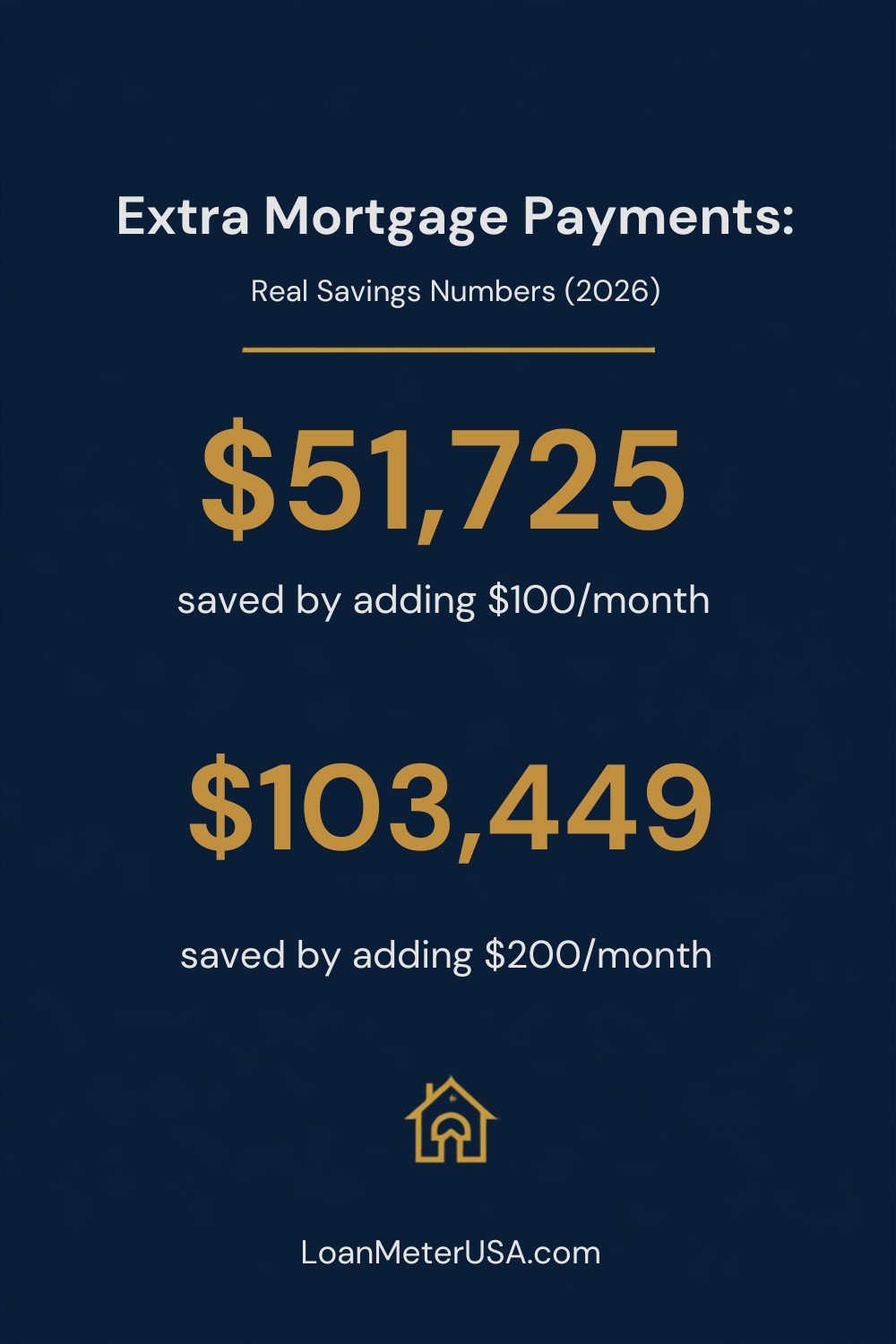
But most people have no idea how much it actually saves. On a $300,000 loan at 6.5%, adding just $200 extra per month saves you $103,449 in interest and cuts 7 years off your 30-year mortgage. That’s not a rounding error – it’s a real, calculable number.
This article breaks down exactly how extra mortgage payments work, with real savings tables at current interest rates, a lump-sum comparison, and four free methods anyone can use starting today.
Every extra mortgage payment you make reduces your principal balance directly – and since mortgage interest is calculated on the outstanding balance, even small extra mortgage payments compound into massive long-term savings. Understanding how extra mortgage payments work is key to taking full advantage of this strategy.
Why Extra Mortgage Payments Work So Powerfully
To understand why extra payments save so much, you need to understand how mortgage interest is calculated. Every month, your lender charges interest on your remaining balance. On a $300,000 loan at 6.5%, that’s $1,625 in interest in month one – out of a total $1,896 payment. Only $271 goes to principal.
This is why mortgages are called “front-loaded.” In the first year of a 30-year mortgage, roughly 80–85% of every payment goes to interest. The loan is designed so that the bank gets most of its money first.
When you make an extra principal payment, you skip ahead on that amortization curve. Less balance means less interest charged next month – which means more of your regular payment goes to principal – which means even less interest the month after that. The effect compounds forward across every remaining payment.
Extra Monthly Payment Savings Table ($300K at 6.5%)
Here’s exactly what different extra monthly payment amounts do on a $300,000 loan at 6.5% over 30 years (base payment: $1,896/month, total interest without extra payments: $382,633):
| Extra/Month | Total Interest Paid | Interest Saved | Loan Paid Off | Time Saved |
|---|---|---|---|---|
| $0 (base) | $382,633 | – | 30 years | – |
| $50 | $349,052 | $33,582 | 27 yr 10 mo | 2 yr 2 mo |
| $100 | $321,639 | $60,995 | 26 years | 4 years |
| $200 | $279,185 | $103,449 | 23 yr 1 mo | 6 yr 11 mo |
| $500 | $202,874 | $179,759 | 17 yr 6 mo | 12 yr 6 mo |
| $1,000 | $141,471 | $241,162 | 12 yr 9 mo | 17 yr 3 mo |
Even $50 extra per month saves $33,582 and takes 26 months off a 30-year mortgage. The returns scale fast as the extra amount increases.
What If You Make a Lump-Sum Extra Mortgage Payment?
Tax refunds, bonuses, and inheritances give homeowners the option to make a one-time lump-sum principal payment. Here’s how those play out on the same $300,000 loan at 6.5%, applied in year one:
| Lump-Sum Amount | Interest Saved | Time Saved |
|---|---|---|
| $1,000 | $5,544 | 3 months |
| $5,000 | $26,567 | 16 months |
| $10,000 | $50,530 | 31 months |
| $25,000 | $110,354 | 5 yr 11 mo |
A $10,000 lump sum – a solid tax refund year – saves over $50,000 in interest. Apply it in year 1 and that single payment works for you across the remaining 29 years.
The Best Time to Start: Why Earlier Wins Every Time
Because amortization front-loads interest, the earlier you start extra payments, the more each dollar saves. A homeowner who starts paying $200/month extra in year 1 saves dramatically more than one who starts in year 15 – even paying for the same number of years.
This is also why paying off a 30-year mortgage in 20 years is achievable without massive extra payments. Start early, be consistent, and amortization math does the heavy lifting.
4 Free DIY Methods to Make Extra Payments
1. Round up your payment. If your mortgage is $1,896/month, pay $2,000 instead. The $104 difference goes straight to principal. Set a slightly higher autopay amount – lowest friction method.
2. The 1/12 method. Divide your monthly payment by 12 and add that amount to each payment. On a $1,896 payment, that’s $158 extra per month. Over 12 months you’ve made one full extra payment – same result as biweekly, with complete flexibility.
3. Apply windfalls to principal. Tax refund, work bonus, birthday money. Even a single $2,000 windfall applied to principal in year 1 saves over $10,000 in interest.
4. Biweekly + extra. If you’re already on a biweekly mortgage payment schedule, you’re automatically making one extra payment per year. Layer a small extra amount on top and you’re running two strategies simultaneously.
Extra Payments vs. Biweekly vs. Refinancing: Quick Comparison
| Strategy | Cost to Set Up | Flexibility | Interest Savings (est.) |
|---|---|---|---|
| Extra monthly principal | $0 | High – change anytime | $34K–$241K depending on amount |
| Biweekly payments | $0–$400 | Medium | ~$60K–$80K on $300K at 6.5% |
| Refinance to 15-year | $3K–$6K closing costs | Low – locked in | $100K–$150K but higher payment |
| Lump sum | $0 | High – any time | $5K–$110K depending on amount |
Should You Make Extra Mortgage Payments or Invest Instead?
At today’s rates (6%–7.5%), paying down your mortgage is a guaranteed, risk-free 6–7.5% return. The stock market averages ~7–10% annually but with significant volatility. The clean framework: emergency fund first, full 401(k) match, zero high-interest debt – then direct extra cash to your mortgage.
Common Mistakes to Avoid With Extra Mortgage Payments
Making extra mortgage payments is straightforward, but a few common mistakes can cost you the savings you’re working toward. The most important rule: always confirm with your lender that extra mortgage payments are applied to principal reduction, not to your next scheduled payment. If they’re applied to future payments, you won’t reduce your balance faster – the interest savings disappear.
A second common mistake is making extra mortgage payments without an emergency fund. Before you accelerate your payoff, make sure you have 3–6 months of expenses saved. Unlike a brokerage account, the equity in your home isn’t liquid – once you pay extra, you can’t easily get that money back without refinancing or a home equity loan.
Third, check whether your mortgage has a prepayment penalty. Most modern loans don’t, but some older loans and certain ARM products include penalties for paying down the balance too quickly. A quick call to your lender will confirm whether extra mortgage payments are penalty-free on your specific loan.
How to Start Making Extra Mortgage Payments Today
Starting extra mortgage payments requires just three steps. First, call your lender or log into your online account and confirm that additional payments go directly to principal. Most lenders have a checkbox or field for this. Second, decide on your extra payment amount – even $50 per month makes a meaningful difference on a $300,000 loan. Third, set up the payment as automatic if possible so extra mortgage payments happen consistently without you having to remember each month.
If you receive a tax refund, bonus, or inheritance, consider making a lump-sum extra mortgage payment. A single $5,000 payment in the early years of your loan can eliminate tens of thousands in lifetime interest – often delivering a better return than the same amount in a savings account or CD.
Use our free mortgage payoff calculator to model exactly how much your specific extra mortgage payments will save based on your current balance, interest rate, and remaining term.
The Consumer Financial Protection Bureau (CFPB) also explains how mortgage interest works and why reducing your principal through extra mortgage payments is one of the highest-return moves available to homeowners.
Taking action on extra mortgage payments today – even a small amount – is one of the highest-return financial decisions available to any homeowner. The math never lies.
Run Your Own Numbers
The savings above are for a $300,000 loan at 6.5%. Your loan will give different, personalized numbers. Use LoanMeterUSA’s free mortgage payoff calculator to model your exact situation – enter your balance, rate, and try different extra payment amounts to see the real impact.
For a deeper look at how your lender calculates each payment and why the first years are so interest-heavy, see our guide on understanding your mortgage amortization schedule.